15 November 2013

NEW TO WMU: Clarkson's World Fleet Register


For the past year, WMU staff and students have enjoyed access to Clarkson's Shipping Intelligence Network , one of the premier databases for accessing shipping market reports, fixtures and transactions. At least two students from the Class of 2013 relied on data supplied by SIN for their recently-completed dissertations. Based on their feedback, and on the fact that Clarkson's has once again offered us a very good academic discount, we took out a subscription to SIN's companion database, Clarkson's World Fleet Register.

This database allows users to query and get "tabular data" on vessels by flag, owners, builders, class and nationality, with breakdowns by ship type and vessel characteristics, including GT, Dwt, Draught, Speed, Beam, fuel type and more. WFR additionally provides orderbook details on more than 8,000 ships from over 600 shipyards worldwide. As with SIN, the database has a sophisticated "Time Series" report generator as well as chart making functionality for pulling together and displaying unique cross sections of information from more than 90,000 vessels. Search results can also be downloaded in spreadsheet format.

As it does with the Shipping Intelligence Network, Clarkson's provides its own regular reports for The World Fleet Register. These can be downloaded and saved as PDFs.

User access to WFR is based on being within the WMU IP range AND having the user name and password for the WMU account. WMU staff and students who are not on campus will be prompted to log in with their WMU email accounts, which will then give them "proxy" access as if they were in the WMU domain.

However, the access process is a bit weird after that. Clarkson's gives WMU site-licensed access for the price of a single private user (otherwise we simply could not afford it), but that single user is yours truly, the WMU librarian. Therefore, it is my email address that is required as the user name on the WFR login form. And you will need the password from the library as well. We are not worried about the user name and password being passed out, because IP or proxy access is required anyway.

When downloading reports, a pop-up box appears stating that this account belongs to Chris Hoebeke and you are asked to confirm that you are -- well, me. Go ahead and lie and click "Accept." You aren't actually violating our terms of access; this is just a quirk of our arrangement with Clarkson's and the defaults of their authentication system.

As with the case of SIN, this database is for ACADEMIC RESEARCH PURPOSES ONLY. Using it for commercial purposes will jeopardize WMU's special access rights.

Anyway, we encourage students and staff to give it a try. Ask the library for the password, use it with my email address, and agree to store the password in your browser for next time.

Let us know what you think.

24 October 2013

Introducing laptop checkout at WMU

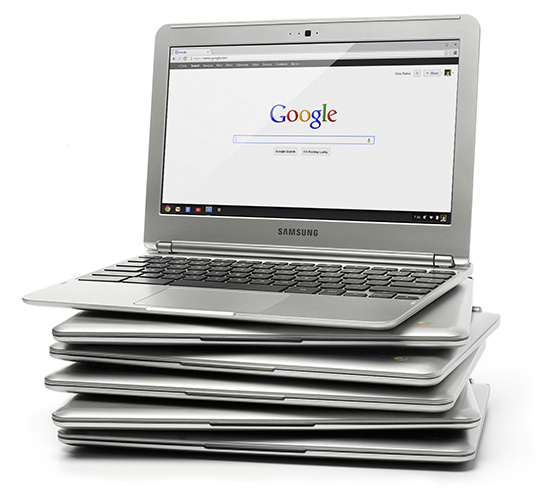
This week, WMU library inaugurated a new service: Laptop checkout. Using low-cost, low-maintenance "Chromebooks" produced by Samsung, the library acquired 5 lightweight, highly portable computers that students, visiting professors, or even walk-in researchers can borrow for use in the library.

The Chromebooks are something of a revolution in computing the last couple years. Based on the internet-centric "Chrome OS," with small hard drives (16GB) and no installable desktop apps like Microsoft Word or Excel, the Chromebook certainly does not fit every laptop use case, but for the library they are a near perfect fit.

Retailing at 249 US dollars made them affordable enough to get a small fleet of them. All the set up and administration is performed remotely through the university's Google Apps admin site. Each computer is enrolled in a group, and changing the settings for the group automatically changes the settings for all Chromebooks in the group. Settings include permissible sites (whitelist), forbidden sites (blacklist), the browser homepage, and what apps and web sites are automatically opened at startup. Google also updates the operating system incrementally in the background, so bugfixes and enhancements are automatic. No need to take a device out of service to install patches and upgrades. The operating system is always up to date.

This not only cuts down on the time library staff have to spend on laptop maintenance, but it allows for highly configurable user sessions that can be set on the basis of who the user is (professor, student, guest, etc.) or what department the Chromebook is registered with. Administrators may allow a guest session, for example, so that walk in patrons can just start browsing the web, or they can set sessions based on the user's Google Apps id. When a WMU user logs in to one of the library Chromebooks, the library catalog and databases pages are ready to be used. One click of the envelope icon at the bottom of the screen, and the user's email opens in another tab. The same for Calendar, Drive, Google Plus, Contacts, and the other Google Apps. Because the session is tied to the WMU id, third party services that authenticate through the Google Oauth service, such as Ebrary, WMU's New Academic site, and the library's beta discovery tool, The Beacon, all can be directly accessed just by logging into the Chromebook. The session will even include the user's bookmarks and extensions that were already installed in a Chrome browser on another computer.

Once the user ends the session, no trace is left on the local computer. No data is stored locally. Another user can log into the same Chromebook with a completely different custom session, while the previous user can log into Google Apps from any computer in the world, and take up wherever he or she left off in the Chromebook. Although they are equipped with two USB ports (as well as SD card slot, HDMI output, audio jack, built-in microphone and camera), there's no need to download files to USB sticks, since they can just be stored in Google Drive and accessed anytime later from a web browser.

The library's Chromebook fleet joins the catalog computer, the machine at the stand up workstation next to the entrance used for looking up the locations of materials in the library's physical inventory. That computers is a Chromebox -- pretty much the same system, except that it requires an external mouse, keyboard and monitor. Unlike its laptop counterparts, the box has been set up in "Kiosk" mode. Logging in is not required to start a session, but the anonymous session is customized to bring up the library catalog and home page. The idea is to reserve this workstation for quick lookups of call numbers. For more involved research, users can avail themselves of a Chromebook.

In either type of device, the operating system (OS) is the same, Chrome OS. Basically, the Chrome operating system is the Google Chrome browser. It has been criticized for its lack of support for power "productivity tools," its small hard drive and its inability to do much without an internet connection. Certainly, this is a valid objection to those who need processor- and memory-intensive applications for video editing, but the "Apps" that are available for online use are growing in number and the range of their power and functionality. The library staff manipulate images of scanned book covers, for instance, using Pixlr editor, without downloading the file or leaving the Chrome browser. And while Google Spreadsheets don't have all the bells and whistles of Microsoft Excel, it probably has more than enough to get most jobs done. Google Presentations compare well with PowerPoint, with the added advantage that presentations are stored in the cloud and available from any web browser, as well as the fact that they can be shared with collaborators rather than having to be sent out in separate attachments and (sent back as attachments that have to be collated). And any App the user has installed in the Chrome browser on his or her personal computer is available on any other machine with a Chrome browser, including the library Chromebook.

But the arguments for the Chrome OS in the educational environment can wait for another post. The critical point for WMU researchers is that the library offers almost all of its collections and services through the web (even items in the print collection are discovered via the web-based catalog). And now it is offering lightweight laptops configured for easier access to those collections and services, with easy storing and sharing of information, single sign on to multiple services, and worry-free security.

So if you happen to have a couple of hours on campus to spare, come on by the library and check one out. Literally.


04 March 2013

The taxonomy of maritime information


I was recently cataloging a work on port state control, for which there is no term in the Library of Congress' list of Subject Headings, so I looked up the book in the Library of Congress catalogue to see how it was categorized in their system. To provide access by the subject matter, the LOC catalog record applied the following five headings:
    • Harbors--Safety regulations.
    • Ships--Safety regulations.
    • Ships--Inspection.
    • Jurisdiction over ships at sea.
    • Law of the sea.
  • While all of these subject terms are relevant, none of them are on target, nor do they accurately hit the mark even when taken collectively. A good cross-referencing system would of course direct researchers to these broader, narrower and related terms, but students of maritime affairs researching such a topic would consistently, if not unanimously, start their search with the term "Port state control." LCSH does not even have a SEE or USE reference from this term, so searching or browsing by subject terminology in this instance is for all intents and purposes a useless endeavor.
I could provide plenty of other examples, but this single instance demonstrates the library's need to supplement LCSH with terminology actually used in the maritime sector. Today's researcher might ask why, in the era of online searching, when the entire text of a document can be searched, there is any need to apply subject terminology at all. Is it just slavish dedication to the practices of the past, with librarians transcribing and recording information according to the traditions of their monkish predecessors, simply for the sake of continuing the traditions?

I would answer that question with another: What if the document being searched nowhere uses the term that the user is searching for, but the content itself is exactly what the user is looking for? What if, for example, an author wrote an essay using the terms "ocean pollution," "pollution of the sea," "oil spill in the Gulf of Mexico," and even made a reference to "MARPOL," but never once employed the term "marine pollution," which happened to be the term that the online researcher was using to find material on this subject? 

Or consider the opposite problem, when the user searches for a term widely accepted as authoritative in his profession or field of study, but the same term is also used extensively in an entirely different context. Searching the web for documents on "piracy," for example, can be as frustrating for the user researching acts of kidnapping and robbery at sea as for the user researching violations of copyright.

Such problems are common enough when searching full-text documents. In the case of most library catalogues, where the printed text of the book is on the shelf and only a brief description of it is available for online searching, the odds of users missing out on relevant materials or having to wade extensively through irrelevant materials would be at least as great.

The librarian attempts to provide the researcher with greater "recall" (comprehensiveness of results), without sacrificing "precision" (relevance of results), by means of a "controlled vocabulary." The idea is that a single term is selected to represent a concept, regardless of whether that term is used in the document itself, and all documents using variations of the term, variations of spelling, synonyms, etc., are assigned to that term. To aid users, those variations and synonyms are often given entries in the database which point the user to the "authoritative" term.

Controlled vocabulary is likewise used to distinguish between homographs (identically spelled words with different meanings), or to distinguish between two or more concepts that use the same words (a process known as "disambiguation"), usually by appending a clarifying word or phrase. For instance, Library of Congress Subject Headings distinguishes the concept of "Piracy" on the high seas from "Piracy (Copyright)."

The cataloger or indexer is guided in the selection of controlled vocabulary by means of a thesaurus. The thesaurus can also be used within the online search system itself to provide cross references that direct users from synonymous terms to the proper "heading" or to indicate distinction of concepts. The more comprehensive thesauri also will point users (and catalogers assigning subjects) to broader, narrower and related terms.

Needless to say, maintaining a thesaurus is a great deal of work. Library of Congress has been maintaining LCSH since 1898, and its list of established headings now numbers in the millions. For general works, and many specializations, there is probably no better thesaurus, but as noted at the outset of this article, its vocabulary is limited and imprecise in many areas having to do with maritime research.

While the WMU library is not staffed to build and maintain a thesaurus of maritime terminology from scratch, it is looking into existing work that could be used as a supplement to LCSH. The Transportation Research Board of the National Academies maintains the Transportation Research Thesaurus, or TRT, which obviously bears looking into. Also, Professor William Tetley's Glossary of Maritime Law Terms is hosted on the McGill University web site. The glossary is in its second edition, and provides excellent cross references. Unfortunately, it does not appear to have been updated since June of 2011.

But it does include the term "Port state control."

25 January 2013

More digital content through Ebrary

Ebrary, the brainchild of Christopher Warnock and Kevin Sayar, was founded in 1999 to make books available online. It is now the leading e-book provider to libraries and researchers worldwide, and in 2011 was purchased by the titan database corporation, ProQuest. As of this writing, Ebrary's website claims the service hosts 595,995 documents with 6,915 added in the past 30 days. Of those, the World Maritime University Library offers its patrons unlimited access to more than 78 thousand titles in the "Academic Complete" subscription. The cost: $6097 per year.

Of course, as with many databases sold as "academic packages" -- the maritime content can be hit or miss. But WMU students need access to more general works as well. The Ebrary subscription is well stocked with up to date works on management, statistics, economics, general science, etc. In some cases, library staff have discovered and provided Ebrary links to assigned reading materials that no longer need to be rotated on "short loan" (a tedious and expensive arrangement whereby the library purchases and houses multiple copies of textbooks -- never enough for everyone -- which are in demand for only two weeks a year). We invite the WMU faculty to peruse the offerings for more Ebrary books that could be used in their classes. After all, they have already been paid for.

The list of titles of specific interest to maritime research seems to be growing. There are books on oceanography, marine pollution, oil spills, shipping, ship recycling, piracy, maritime law and law of the sea (the works of Grotius as well as 21st Century titles). Several titles acquired by the library in print over the last few years are now available as e-books that can be accessed by all WMU patrons simultaneously, including Ports in Proximity, Flagging Standards, and Shipping Innovation There are actually more Ebrary books on the topic of "supply chain management" than the library has on shelf.

What is making Ebrary more relevant to the study of maritime affairs is the list of e-books available outside the subscription package. The 78 thousand titles in Academic Complete can now be supplemented with e-books selected individually from hundreds of thousands of other titles. Publishers getting into the e-book business are basically outsourcing the discovery interface, the customer e-licensing and the distribution concerns to a company with a well-established architecture and business model. Larger publishers already providing e-books on their web sites are finding that their library customers appreciate being able to subscribe to a single source for e-content management. Consequently, whether or not a particular title is available in the library's Academic Complete subscription, worthy publications in maritime affairs are being made available for single title purchase.

Ebrary has also extended a role to the patron in building a library's e-collection. Library staff can issue accounts to faculty, for instance, which enable them to find and recommend purchases. The librarian reviews the recommendations and either approves, rejects or defers the purchase. Approved orders are instantly available online.

And as of 25 Jan 2013, WMU library users have the opportunity to participate in Ebrary's "Patron Driven Acquisition." Under this program, library staff can set aside a budgeted amount and set up pre-approved purchase lists based on subjects, publisher, price and other criteria, but no charge is made until a patron actually commits to reading the book (perusing the table of contents and sampling a few pages does not trigger a purchase).

Meanwhile, all Ebrary books, whether from the subscription package or from individual title purchases, are discoverable and readable through the same interface. To the end user, the different methods of acquisition make no difference in the searching and reading experience.

The title list of the subscription package varies slightly from year to year, depending on Ebrary's agreements with publishers. Cancellation of the subscription, however, does not cancel access to titles the library has purchased. A low annual hosting fee is charged for access, but the titles are owned by the library in perpetuity.

Ebrary is more than a collection of e-books. It is also a scholarly resource that allows users to add  bookmarks and annotations. Words and phrases can be highlighted and automatically looked up in an online dictionary or Wikipedia. Citation data can be exported to major reference management software and services, such as EndNote and Refworks

For patrons who insist they can not read from a PC, Ebrary has apps for Android and Ipads. Depending on publisher's terms, up to 40 pages or one chapter from each book can be converted to PDF, downloaded and retained by the patron in perpetuity. The PDF's read well on a tablet or Kindle. Alternatively, users can download an entire publication in epub format to read on their tablet or e-reader device for up to 2 weeks. Typically, 2 users per institution can download a book for offline reading at a time. When it comes to online reading, most of WMU's titles allow unlimited simultaneous access across the organization.

Usage among WMU patrons has risen steadily for several years. According to the 2012 statistics, for slightly more than $6000, students and faculty accessed materials that would have required ten times that amount to procure in print.

Not a bad deal. Cost of access is a key consideration in building our collection. Ebrary's continued improvement of its services and extension of its title list are proving to be a key component in our stock of monographic material.

Patrons wanting to know more about Ebrary or to get hands on training are encouraged to contact the library staff.


15 January 2013

Marine Money's "Official Guide to Ship Registries Online" : commercial publishing gumming up the flow of maritime information -- for a profit

A Phd student came to the reference desk not long ago, asking if we had a more recent edition of the Guide to international ship registers and ship management services, by Lloyd's Ship Manager. He handed me the 2000 edition of the annually issued catalog of flag states with open registries.  Under each state was typically a two page entry of facts that would be useful in determining if it was the right place to register a particular vessel, organized generally under the following headings:
  • Principal laws applicable to ship registration
  • International conventions adopted
  • Port state control
  • Registration requirements
    • Age
    • Surveys
    • Ownership
  • Procedure for ship registration
  • Contacts
  • Parallel registration
  • Mortgages
  • Registration fees
  • Manning requirements
Each entry also included a short narrative of the founding of the registry, and often charts showing historical performance in terms of number of vessels, tonnage and how well their registrants faired  on average under Port State regimes (e.g., detention rates).

Lloyd's Guide, published in association with the International Shipping Federation, was by no means comprehensive, considering it only listed open registries, but then, the likely customer for such a publication would probably have been looking for a flag of convenience anyway. Considering its intentionally limited coverage, this paper-based data set was a fairly current, and easy to navigate source of information. Still, for the maritime researcher, the inclusion of all the world's registries would have proven useful in deriving correlations between registration standards and vessel performance. And for vessel owners with multi-national ties, a unified source of registry information would have offered considerable convenience when weighing flag options.

But to answer the student's question, no, the library did not have any newer issues. After searching several sources, including WorldCat, I began to suspect that the publication had ceased not long after 2000. When I searched "ship registries guide" in Google, the first link was to the Official Guide to Ship Registries Online & International Shipping Review Online

This online version is published by US-based Marine Money, and boasts of being the publication group's "most comprehensive guide yet," with fees, regulations and contacts from over 100 flag states. It was designed, according to the home page, to put "up to date information for the world's Ship Registers at your fingertips," and even went so far as to predict "Savings of up to $50,000 per ship per year when you comparison shop using the Guide."

Having taken a subscription ($500) on behalf of our researcher, I have absolutely no idea how any of Marine Money's claims can be maintained. The Guide indeed lists entries for over 100 flag states, but the presentation of data, and the amount and type of data contained, is wildly inconsistent. Each flag state gets its own site -- consisting of a page or series of pages linked by menus, but in the case of many states, the site provides only a sample of information, with links directing users to various agency pages for further details. The link to Gambia directs users to a PDF of pages 145-146 from the 2002 print edition!

In some cases, the entries are outright laughable. Clicking the "Introduction" link under Tunisia, for instance, yields the following information "About the flag":
Lorem ipsum dolor sit amet, consectetuer adipiscing elit. Donec molestie. Sed aliquam sem ut arcu. Phasellus sollicitudin. Vestibulum condimentum facilisis nulla. In hac habitasse platea dictumst. Nulla nonummy. Cras quis libero. Cras venenatis. Aliquam posuere lobortis pede. Nullam fringilla urna id leo. Praesent aliquet pretium erat. Praesent non odio. Pellentesque a magna a mauris vulputate lacinia. Aenean viverra. Class aptent taciti sociosqu ad litora torquent per conubia nostra, per inceptos hymenaeos. Aliquam lacus. Mauris magna eros, semper a, tempor et, rutrum et, tortor.
This "Lorem ipsum" text is known in the graphical design business as "greeking" -- the filler text that page layout experts and web designers use when building style sheets to ensure uniformity of typeface, font size, spacing, etc., across the document or site. The error is even more comical when one considers how basic and immature the style actually is. To all appearances, the Guide's web pages look like a slight modification of Google Sites, which is included in the Google Apps suite and is intended for simple intranet-like web sites maintained by an organization's non-technical end users. Going to the trouble of greeking on a Google Site design would be tantamount to hiring a typesetter to print a shopping list. This at least helps explain why it costs five hundred dollars for something so simple.

Given such inconsistencies in content and presentation, it is hard to fathom how the online Guide could be used for "comparison" shopping. Other than not having to take it physically off the library shelf, the online version offers no extra convenience for the vessel owner looking to register. There are only two ways to get at the data: One, clicking a map of continents and clicking a country; or Two, clicking a letter of the alphabet and clicking a country. As with the print edition, one has to start with the flag, take notes, find another flag, take notes, etc. There is no searching, no filter options, no results formated in tables that would facilitate real comparisons.

The left side of the home page, a space conventionally used for link menus, has a list of content that is supposedly included for each state:
  • Introduction
  • Shipowner eligibility
  • Company formation
  • Taxation
  • Registration & documentation
  • Bareboat charter registration
  • Vessel eligibility & survey requirements
  • Crewing
  • Mortgages
  • Fees
  • Contacts
  • IMO Conventions
Organizing the site in this way, in the form of hypertext links, would make it more useful, but in fact, this list is not only not a menu of links, it is not even computer-readable text. The whole front page is an image, with a few clickable points -- continent or alphabet. So cutting edge, 1993!

It is difficult to verify Marine Money's claim to be the most current data available. But the Guide's simplistic public interface casts doubt on the likelihood of the back end sophistication that would be needed to maintain such an assertion. My guess is its maintainers simply copied and stylized what they could from web sites of flag registries, and where feasible or necessary, used the information from the old LSM publication. There only reason this site could be considered current is that the flag registry information does not change frequently.

In order to be truly up to date, however, the site should offer the appropriate representatives of each flag state an account and a convenient means of entering their own data through standardized web forms. But, as this blog never tires of repeating, if the originators of maritime data were to maintain their information in this manner, it would not justify the subscription costs demanded by maritime publishers. Instead of exacting five hundred USD per year per subscriber, there would be a one-time expense to get the database up and running, and maintenance costs could be paid for at a small fraction of the current rate. Perhaps they could even be paid entirely through advertising and offered freely to the public on the open web. Such a product might well save ship registrants considerable aggravation, possibly money as well, but at least as importantly, it would put useful, affordable tools in the hands of maritime researchers.

This idea raises the question of whether there are enough contacts among the alumni of the World Maritime University in the right positions to supply this data if the WMU Library built the interface and provided the storage. It would be an ideal project to test the possibilities of "crowd-sourced" data in the maritime world. Flag states, particularly those with open registries, would presumably have an interest in seeing this data kept up to date as a service to their customers.

In the mean time, the online Guide, at $500 per year, is what those customers currently have at their disposal, with --and I quote-- "the caliber of reporting, content and service you've come to expect from Marine Money publications."

If that is indeed the caliber you have come to expect in maritime information resources, don't forget to "Like" their page on Facebook.