The dearth of recent postings on this blog in no way reflect a lack of energy and effort on the part of library staff to bring more quality information resources and services to WMU library patrons. In fact, after several months of negotiations and background work, the staff is pleased to announce a two month trial for a host of new electronic content as well as a unified interface for searching across many of the library's subscription databases, ebooks and journal titles.
Until 1 September, WMU users will be able to access Ebsco's eBook Academic Collection and Academic Search Premiere article database. In terms of price, coverage, and user reading experience, these two fulltext platforms compete very well with the library's current Ebrary and ProQuest subscriptions. Additionally, we have trial access to Fish, fisheries & Aquatic Biodiversity Worldwide; Waters & Oceans Worldwide and Environment Complete -- databases consisting
of commercial, government and NGO reports and studies aggregated and searchable in a single resource.
 |
| From Infotoday.com |
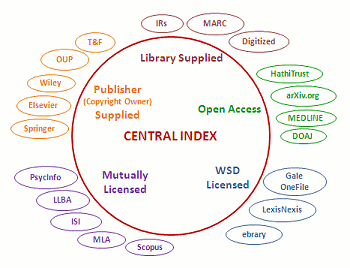
The second service, the URL Resolver, is a massive database of citations with links directly to the full-text offered by all the major providers of that content. If the library subscribes to a journal through Ingenta, for example, but that journal is also available through ScienceDirect, library users will be directed to the full-text on Ingenta. More interestingly, if ScienceDirect provides the library with the last three years of an e-journal, but Ingenta provides back issues beyond that, the resolver will link the user to the right resource based on the year the article was published. To function properly, library staff have to register and maintain their e-journal subscriptions and ebook purchases with the Resolver service, but with the growing number of electronic texts being added to our collections almost daily, it is well worth the effort.
The use of a unified search interface like EDS would not be nearly as effective without the resolver service. For discovery purposes, users have the option of searching a much larger universe of content than that owned or leased by the library, but because the Resolver contains library subscription information, users can also limit results to "Available in the library collections." For example, using the latter option, instead of retrieving citations from all of Taylor & Francis' e-journals, they would only get results from Maritime Policy & Management and the handful of other titles that the library subscribes to through T&F. Likewise, search results could be retrieved from all the content of ScienceDirect -- with links to purchase requests for articles not owned by the library -- or just from the hundred or so individual articles that the library has already purchased and is permitted to store in its local repository.
Not that the library is ready to provide this level of convenience. What the Ebsco Discovery Service and OpenURL Resolver offer at present are the materials and tools to build an information retrieval system unique to the needs of WMU and the community of maritime researchers. They offer a great step forward in allowing the library to include databases, or portions of databases, or single e-journal titles, as well as local digital repositories, all within a single search.
Moreover, against any of these aggregations of content it is possible to set hidden search limiters and expanders in order to achieve more relevant results without sacrificing too much comprehensiveness, and vice-versa. For instance, with limiting descriptors, a search for "port state control" would not retrieve articles on computer motherboards, and searching for piracy would not entail scrolling through pages of citations about illegal downloads and copyright violations. By contrast, with expanding descriptors, content about maritime law could be retrieved in a search for "Admiralty Law" even when the retrieved content does not actually include the latter term. In this way, a whole system of cross-references and guides can be developed over time to glean meaningful maritime content from the wash of online information.
Moreover, against any of these aggregations of content it is possible to set hidden search limiters and expanders in order to achieve more relevant results without sacrificing too much comprehensiveness, and vice-versa. For instance, with limiting descriptors, a search for "port state control" would not retrieve articles on computer motherboards, and searching for piracy would not entail scrolling through pages of citations about illegal downloads and copyright violations. By contrast, with expanding descriptors, content about maritime law could be retrieved in a search for "Admiralty Law" even when the retrieved content does not actually include the latter term. In this way, a whole system of cross-references and guides can be developed over time to glean meaningful maritime content from the wash of online information.
EDS can be configured for different user groups, not only the branding, but the databases to be searched and the default settings to be applied in search and retrieval. This might possibly allow customization for MSc specializations or the university's research groups. EDS also has an Application Programming Interface (API) that allows customer institutions to build interfaces and functionality on top of the EDS retrieval system. One very interesting application already developed and shared with the EDS "user community" integrates the Ebsco discovery service with the Moodle Learning Management System, allowing instructors or their designees to search for full-text content from within the LMS and to provide e-content links straight from their course reading pages.
 Now, however, we have the bricks and mortar, the lumber and nails, and a simple blueprint to begin the work. During the trial EDS will not search the library's catalogue of local holdings, but while we are working on that, we have provided a library Start Page that will make toggling between the two systems more manageable. The EDS will also not search the Clarkson's databases, given that Clarkson's is used for generating data tables rather than for retrieving full text documents. Nor will EDS integrate with titles published by Informa Lloyd's or IHS Fairplay, as neither of these two information empires have come to appreciate the wisdom or profitability in providing bibliographic aggregators like Ebsco and ProQuest with the metadata that drives online discovery. Nevertheless, to the extent possible we will provide links and references to these resources.
Rather than waiting to roll out a finished product, the library is releasing the service as developed until now, with plans to make frequent, iterative, improvements. In fact, given the overwhelming configuration options, it would be arrogant to imagine ourselves competent to determine all the possible uses and customizations to which the discovery service can be put without hearing ideas from our patrons. We are therefore asking our users to get involved at the earliest stages, and to stay involved. Taking into account your suggestions and criticism, as well as features and fixes we already have in mind, we hope to make enhancements on a weekly basis. And, should we decide to license the EDS after the trial period, we plan to continue developing it and linking new content and services in accordance with the evolving research needs of our patrons.
This is but the first invitation. We plan to make this offer door-to-door if that is what it takes to get your participation. The reward for participating is access to more maritime scholarship, discoverable through a single search box.
Check it out for yourself.

No comments:
Post a Comment